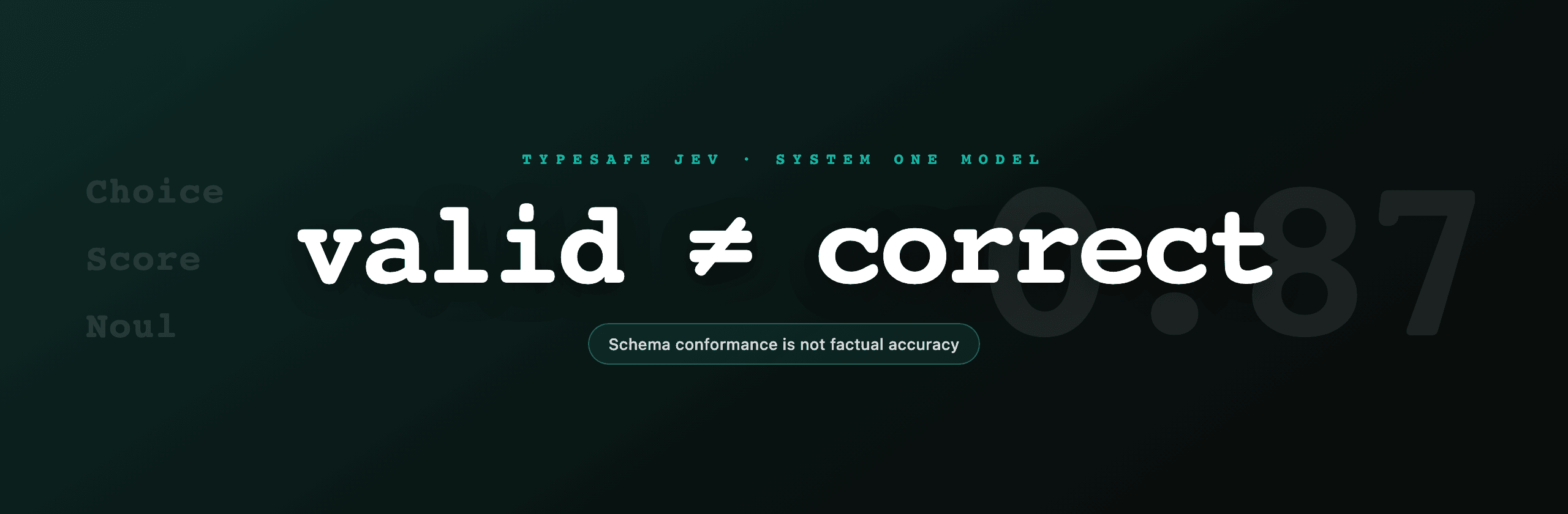
TypeSafe opened early access to Jev this month and the summary circulating everywhere is "an AI model that cannot hallucinate". That summary is wrong, and the way it is wrong matters more than the model itself. Jev guarantees that its output conforms to the schema you defined. It guarantees nothing about whether the answer is true.
Those are two different properties, and the gap between them is where production incidents live.
What is a System One model?
A System One model is a model built to return typed decisions rather than text. TypeSafe's documentation defines the class directly: "System One models are a class of AI models built to make fast, structured decisions that software can use directly." Jev is the first one, described as "TypeSafe's flagship model and the first System One model".
The practical consequence is that Jev has no text generation path. It cannot write a sentence, a JSON blob, a code snippet or a refusal. You hand it a state, which is whatever unstructured context you have, plus a set of typed questions. It hands back typed answers with probability distributions. Your code branches on those values without parsing anything.
That is a narrower contract than an LLM offers, and narrowness is the point. The output type is fixed before inference starts, so there is no parse step, no retry-on-malformed-JSON loop, and no prompt instruction telling the model to please respond only with valid JSON.
What are Choice, Score and Noul?
Jev exposes exactly three question types, and every use case is built from them. Per TypeSafe's primitives documentation:
- Choice selects one option from a defined set. It returns
choice(the option with the highest probability),probabilities(the full distribution, summing to 1) andconfidence(0 to 1, derived from how spread out the distribution is). A Choice question accepts up to 255 options. - Score places the state on an ordered rubric. It returns
score,probabilitiesandconfidence. - Noul answers whether a statement is true. It returns a single value between 0 and 1, with no separate confidence field, because the probability is already the answer.
Confidence is a shape measurement, not a truth measurement. The documentation is explicit: "The shape of that distribution is what tells you how certain the model is: concentrated on one outcome means a confident answer, spread out means an uncertain one." A distribution concentrated on one wrong option produces a confident wrong answer, and the API has no way to signal that.
What does "cannot hallucinate" actually guarantee?
It guarantees that the returned value exists in the set you declared. Nothing more. TypeSafe's launch post says existing models "still hallucinate and have type errors" and that Jev "can't hallucinate". Read strictly, that claim is about type errors. Read the way most people read it, it sounds like a correctness guarantee, and it is not one.
TypeSafe's own System One documentation contains the sentence that should be quoted alongside every "zero hallucination" headline:
Calibration is measured across groups of predictions; it does not guarantee that an individual answer is correct.
That is the whole distinction in one line. Calibration is a statistical property of a population of answers: if the model says 0.8 across a thousand cases, roughly eight hundred of them should be true. It says nothing about the case in front of you. A Choice question with five options will always return one of those five. If the correct answer was not among them, or if the model picked the wrong one, you receive a perfectly well-typed wrong answer, with a confidence number attached, and your code will act on it.
So "zero hallucination" is an abuse of language. The accurate version is: zero invalid values. That is genuinely useful. It eliminates an entire class of integration bugs, the ones where you wrap a model call in a schema parser and a retry loop. It does not eliminate the class of bug where the model is simply wrong, and that second class is the one that ships bad invoices to customers.
Jev vs LLM structured outputs vs code-side validation
Three different tools solve three different problems, and they are routinely confused. A schema validator checks syntax. An LLM with structured outputs guesses semantics and emits syntax. Jev guesses semantics inside a fixed type. Only the first is deterministic.
| Property | Jev (System One) | LLM with structured outputs | Schema validation in code |
|---|---|---|---|
| Output always matches the declared type | Yes, by construction | Usually, enforced by constrained decoding | Yes, it is the definition |
| Can the answer be factually wrong | Yes | Yes | Not applicable, it judges nothing |
| Deterministic for the same input | No, it is a model | No | Yes |
| Returns a probability distribution | Yes, per question | No, only the chosen value | No |
| Returns calibrated confidence | Yes, Choice and Score | No native equivalent | No |
| Can produce free text or an explanation | No | Yes | No |
| Streams tokens | No, per the Spring AI notes | Yes | Not applicable |
| Handles a judgment no rule can express | Yes | Yes | No |
| Catches a malformed payload | No, that is not its job | Incidentally | Yes, reliably |
| Cost per call | Vendor-published, very low | Generation tokens | Effectively zero |
The row that decides your architecture is the second one. If a wrong-but-valid answer is unacceptable, none of the first two columns helps you, and the correct move is a deterministic check. If the judgment cannot be expressed as a rule at all, the third column is not available and you are choosing between the first two on cost, latency and whether you need an explanation.
Where do the performance numbers come from?
Every figure published about Jev comes from TypeSafe. The launch post claims "193.6x faster, 444.6x cheaper" against frontier models, an end-to-end response time of "70ms-500ms" against "3 to 329 seconds", and pricing of "$0.042 / MTok" on input with output tokens "FREE (too cheap to meter)". The Spring AI integration post published on 21 September 2026 cites TypeSafe's benchmark as "10x to 125x faster" and "22x to 805x cheaper", with a 14-question call at $0.000043 and 111ms.
Those are vendor benchmarks on vendor-selected workflows. The launch post describes the methodology as using "the predictions of the largest, smartest, and most expensive external models as reference probabilities", which means the reference answer is another model's opinion rather than ground truth. No independent audit of any of these numbers exists as of 22 September 2026.
None of this makes the numbers false. It makes them unverified, and the ranges themselves (10x to 125x, 22x to 805x) signal how much the result depends on which workflow you pick. Reproduce them on your own labelled data before they enter a capacity plan.
Documented integration surfaces so far: Cloudflare references the model as typesafe/jev with a 32,000 token context window and two parameters, state and questions, with the production version listed as jev-1.13.0. TypeSafe ships a Python SDK and a JavaScript SDK. Spring AI added an integration at version 0.1.0 on 21 September 2026, implementing five existing Spring AI interfaces rather than inventing parallel abstractions: a self-refine advisor, a guardrail advisor, a document filter and reranker pair for RAG triage, a tool index, and an evaluator.
Does any of this apply to PDF generation?
One use case holds up, and most of the obvious ones do not. The honest answer for a service like PDF4.dev is that Jev belongs in exactly one place: grading a judgment call that no deterministic rule can express, on a path where a wrong answer is recoverable.
The one that works: print-readiness triage on agent-written templates. When an AI agent writes an HTML template through an MCP tool, the failure modes are not syntax errors. The HTML parses. The Handlebars compiles. The PDF renders. It just looks wrong: a table that splits mid-row across a page break, a footer that collides with content, a font size that produces a nine-page invoice. A Score question against an ordered print-readiness rubric turns that into a number you can route on. High score, render it. Low score, hand it back to the agent with the rubric level as feedback. Middle band, queue it for a human.
This works because a rubric score is inherently fuzzy, a wrong score costs one extra review rather than a corrupted document, and the confidence value gives you a natural threshold for the middle band.
The ones that do not work. Validating an API request body with a billed network call to a third-party model would be absurd when typeof and a required-fields check are free, instant and actually correct. Checking whether a template's Handlebars variables match the supplied data is set arithmetic, not a judgment. Deciding whether a PDF rendered successfully is a question the renderer already answers with a byte count and an exit status. Every one of these has a deterministic answer, and replacing a deterministic check with a probabilistic one is a downgrade no matter how cheap the probability is.
The rule of thumb: if you can write the check as an if statement, write the if statement.
What is missing before you depend on it?
Four things, and they are all availability and governance rather than capability. Jev is in early access behind a waitlist, so you cannot plan a launch around it. TypeSafe's public documentation says nothing about self-hosting and publishes no model weights, so the model runs on their infrastructure or on a partner's. There is a single provider, which means no second source if pricing or terms change.
And the documentation itself acknowledges rough edges: the docs index lists a page on "model jaggedness" for jev-1.13 describing behaviours that "will be fixed in later versions". That is welcome honesty from a vendor, and it is also a direct contradiction of the marketing summary. A model with documented jagged edges is a model that gets individual answers wrong.
How should you evaluate it?
Build a labelled set before you build an integration. Collect two hundred real cases where you already know the right answer, run them through a Choice or Score question, and measure two things separately: how often the top answer is correct, and whether the confidence value actually tracks correctness. Calibration is the more interesting of the two, because a well-calibrated model with mediocre accuracy is still useful if you route the low-confidence band to a human, while a poorly calibrated model is useless at any accuracy.
Then decide where a wrong-but-valid answer costs you something. That question, not the benchmark table, determines whether a System One model belongs in the path at all.
The idea is sound: a lot of what agents do is classification dressed up as conversation, and paying generation-model prices to pick one of four options is wasteful. The framing is what needs correcting. Jev removes type errors. It does not remove being wrong, and the vendor's own documentation says so more plainly than most of the coverage does.
Start generating PDFs
Build PDF templates with a visual editor. Render them via API from any language in ~300ms.